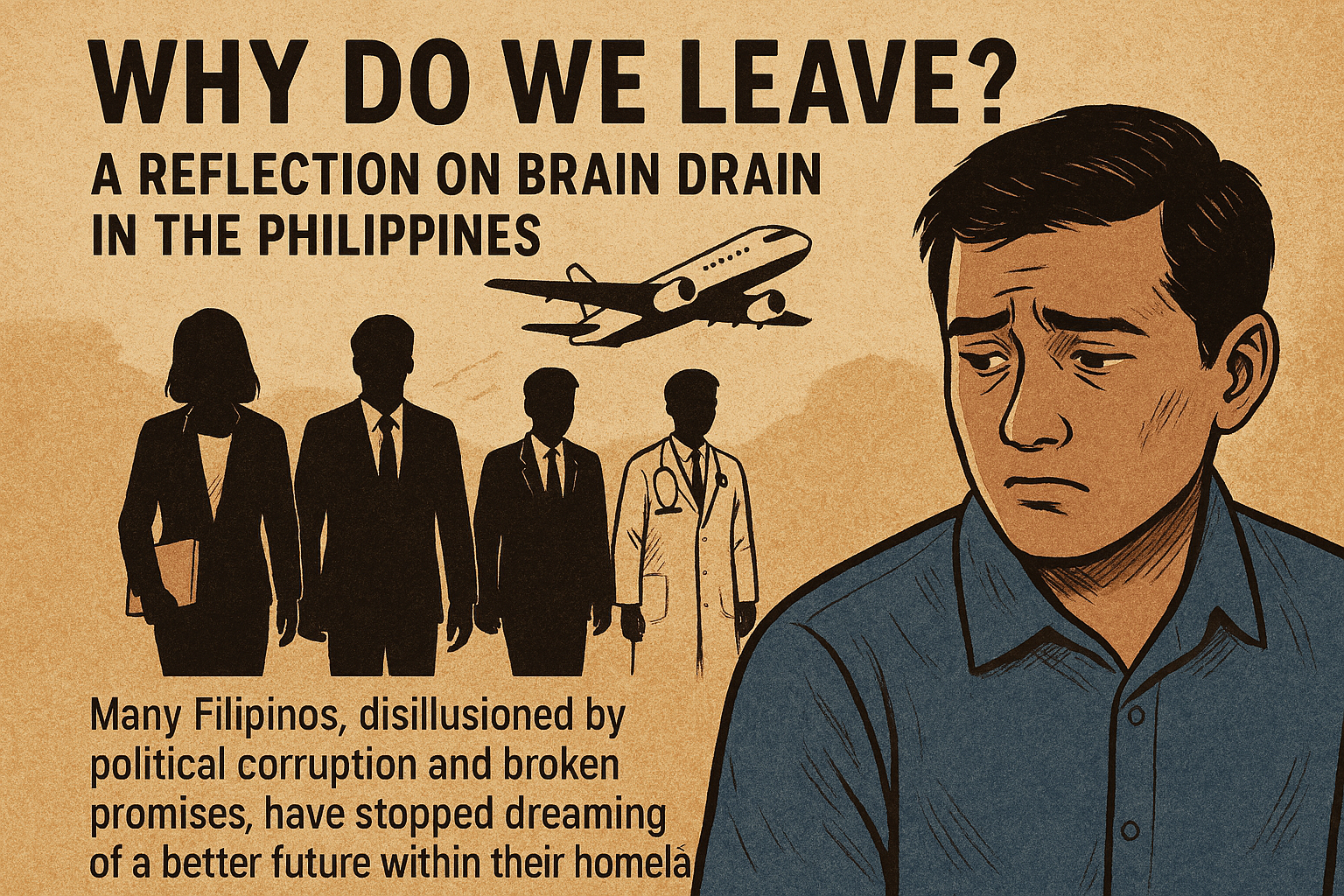
Why Do We Leave? A Reflection on Brain Drain in the Philippines 

The Philippines is a nation rich in talent, resilience, and heart. Yet, it continues to lose its brightest minds to opportunities abroad. This phenomenon—known as brain drain—is more than just migration; it’s a quiet rebellion against a system that has failed to nurture its own.
For decades, many Filipinos have grown disillusioned by political corruption, broken promises, and systemic neglect. The dream of a better future within the homeland fades, replaced by the pursuit of dignity and recognition elsewhere. In countries where merit is rewarded and potential is supported, Filipino professionals find the respect and growth they were denied at home.
Those who stay often feel demotivated to harness their skills, knowing that excellence is rarely acknowledged, and opportunities are limited. The lack of innovation, mentorship, and meaningful career paths stifles ambition. It’s not that Filipinos lack talent—it’s that the system fails to believe in it.
Overseas employment has long been promoted by the Philippine government as a solution to economic hardship. But behind this narrative lies a deeper failure: the inability to build an economy that can support even the basic needs of its people. Instead of creating sustainable jobs and industries, the state has leaned on labor export as a convenient fix—one that generates remittances but masks the cracks in our economic foundation.
In 2024, OFWs sent home a record $38.34 billion, accounting for 8.3% of the country’s GDP and 7.4% of its Gross National Income (GNI). These remittances fuel household spending, education, and healthcare, and are often hailed as a lifeline for the economy. But while families survive, the country stagnates. Remittances are rarely invested in long-term development, and the government becomes increasingly dependent on this inflow—without addressing the root causes of migration.
Filipinos are compelled to work abroad out of necessity, not choice. And while remittances support millions of families, we must ask: who truly benefits from this system? Often, it’s the corrupt and powerful who profit from the status quo—those who exploit the labor of their own people while failing to invest in real progress at home.
The consequences of brain drain go far beyond economics. The Philippines loses thousands of highly skilled professionals each year—doctors, nurses, engineers, IT specialists, educators—who choose to build futures abroad. This outflow deprives the country of the very minds that could drive innovation, reform, and progress.
In 2024 alone, 2.16 million Filipino workers were deployed overseas, many in critical sectors like healthcare and engineering. As a result, local industries face staff shortages, rising costs, and declining service quality. The healthcare sector, for instance, struggles to retain nurses and doctors, leading to overworked staff and reduced access to care.
This talent drain also affects education, science, and technology. The country invests heavily in educating its youth, only to see them leave for better opportunities. Over 80% of permanent emigrants are college-educated, with many heading to North America. The Philippines is effectively subsidizing the workforce of wealthier nations—while its own development suffers.
This is a tragic loss. When our scientists, educators, engineers, and healthcare workers build futures elsewhere, the Philippines forfeits its chance to rise through its own brilliance.
In recent years, the Philippine government has begun to acknowledge the long-term consequences of brain drain. President Ferdinand Marcos Jr. has publicly emphasized the need to bring our people back and reintegrate them into the local economy. His administration has launched retraining programs, expanded livelihood support, and strengthened partnerships with the private sector to ensure that returning workers have meaningful opportunities at home.
“We are putting in place responsive mechanisms for the social welfare, repatriation, and reintegration of our returning OFWs into the Philippine economy.” — President Ferdinand Marcos Jr.
This shift in tone is a positive step forward. It recognizes that the true strength of the Philippines lies not in exporting its people, but in empowering them to thrive within their own country.
The future of our nation depends not only on the brilliance of its people but on the courage to demand better. When leadership stifles rather than inspires, the result is a generation that stops believing in its own potential.
But change begins with awareness—and action. We must educate ourselves, challenge the status quo, and choose leaders who uplift, not exploit. We owe it to every Filipino who left not because they wanted to, but because they had to. We owe it to the children growing up in this country to give them a reason to stay, to dream, and to believe that their future can be built right here—at home.
Let this be our wake-up call. Let this be our turning point. Because the greatest loss is not just the departure of talent—it’s the fading hope of a nation that once believed in its own greatness.
It’s time to reclaim that hope. It’s time to rebuild.